Somebody once told Potato Tiger that fidgeting means you're not paying attention. Potato Tiger was, at the time, kneading a blanket while listening to every single word. So. Let's look at what the research actually says.
Short version: for a lot of brains, especially ADHD brains, fidgeting isn't a distraction from focus. It's how focus happens. But not every fidget helps, and some actively hurt. This article covers the proven benefits, the brain chemistry behind them, and where the hype outruns the evidence.
What's happening in your brain when you fidget
Attention isn't free. Your prefrontal cortex, the part of the brain behind your forehead that handles planning, working memory, and ignoring distractions, runs on two chemical messengers: dopamine and norepinephrine. When those are at the right level, you can sit through a boring lecture. When they dip, your brain goes hunting for stimulation.
In ADHD, dopamine and norepinephrine signaling in these networks works differently, which is why the most common medications target exactly those two chemicals. Here's the part that matters for fidgeters: physical movement, including small repetitive movement, nudges those same neurotransmitters upward. Movement is a cheap, legal, always-available way to top up the brain's alertness system.
Researchers call this arousal regulation. Fidgeting shows up most during long, low-stimulation tasks because that's exactly when the thermostat is dropping. A 2024 study on fidgeting and sustained attention described it as a compensatory mechanism, a way the brain keeps itself in the zone during listening tasks without reaching for something more disruptive, like your phone.
Proven benefit #1: Better focus (for ADHD brains)
This is the strongest finding in the whole field. Julie Schweitzer's lab at UC Davis strapped motion sensors to the wrists and ankles of kids and adults with ADHD during demanding cognitive tests. The result, across two separate studies: participants who moved more performed better. The more intense the task, the more they fidgeted, and the fidgeting tracked with higher accuracy.
The important caveat: the same pattern did not show up in people without ADHD. For neurotypical brains, fidgeting was roughly neutral. So when someone says "fidgeting helps everyone focus," that's an overreach. When someone says "fidgeting helps ADHD brains focus," the data backs them up.
Proven benefit #2: Stress and emotional regulation
This one applies much more broadly. A 2022 review that pooled multiple studies on fidget toys found the most consistent evidence was for emotional regulation and stress relief, not academic performance. Squeezing (think a stress ball or Nee Doh), kneading (Thinking Putty), and repetitive tactile motion give the nervous system a predictable, rhythmic input, which is calming in the same way rocking a baby or petting a cat is calming. (Potato Tiger approves of this comparison.)
Research from UC Santa Cruz led by Katherine Isbister found that people's fidget preferences actually shift with mood: they reach for squeezable fidgets when angry or anxious, and for clicking or tapping fidgets when bored. That's your body self-prescribing different sensory input for different emotional states.
Proven benefit #3: Engagement and getting "back in the room"
A Suffolk University study surveyed 119 students before and after introducing fidget tools into their classes. Before fidgets, 14.4% of students described themselves as "not at all engaged." After, that dropped to 1.1%. Students reporting they felt unproductive fell from 11.7% to 2.2%.
An earlier study of 29 sixth graders using stress balls found 10% saw meaningful test score increases and nearly half reported being less distracted. A longer-term university study tracking 220 students over seven semesters concluded fidget toys helped students who had drifted off refocus on the lesson.
These are self-report and small-sample studies, so take the exact numbers lightly. But they point the same direction: a quiet fidget gives a wandering mind a low-cost way back.
Where the hype is wrong
Fidget spinners are the villain of this story. A 2020 study found third graders using spinners did significantly worse on math tests. Another 2020 study with college students found spinners caused a 44% drop in retention for the user, and a 13% drop for people sitting nearby. The problem isn't fidgeting. The problem is that spinners demand your eyes. Anything you have to watch is competing with the thing you're supposed to be learning.
The pattern across all the research is simple: fidgets that use only your hands help. Fidgets that pull in your eyes or ears compete for the exact attention you're trying to protect.
There's also a cognitive load argument. If a fidget is complex or novel, it eats working memory. The best fidgets are so boring to operate that you forget you're holding them. That's the goal: automatic motion, not a puzzle.
Autism, anxiety, and sensory processing
Most of the controlled research is on ADHD, but the mechanism generalizes. For autistic people and anyone with sensory processing differences, fidgeting is often about regulating input rather than arousal: providing predictable sensory feedback in an environment that's too loud, too bright, or too unpredictable. Occupational therapists have used tactile and proprioceptive (pressure/resistance) tools for decades for exactly this reason.
For anxiety, the calming data above applies directly. Repetitive hand motion lowers physiological arousal, and having an object to hold gives nervous energy somewhere to go. This is why worry beads exist in cultures all over the world and have for centuries. Humans figured this out long before anyone measured cortisol.
So what should you actually use?
If you want the benefits the research supports, pick fidgets that match these criteria:
- Hands only. No visual tracking, no sound. (Fidget rings and worry stones are the purest version.)
- Repetitive and automatic. You should be able to use it without thinking.
- Matched to your state. Squishy/resistance for stress, clicky/tactile for boredom.
- Boring enough to ignore. If it's fun to look at, it's a toy, not a tool.
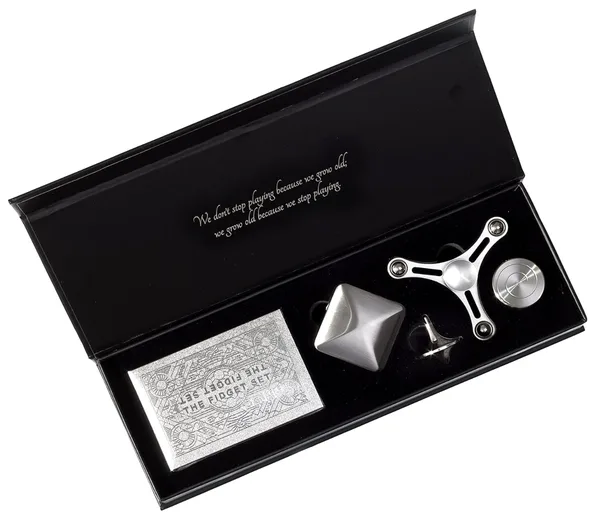
PT's picks that fit the science:


The bottom line
Fidgeting is a self-regulation strategy, not a character flaw. For ADHD brains, the evidence that movement improves focus is solid. For everyone, the evidence that tactile fidgets reduce stress is good. For fidget spinners, the evidence is bad and you should probably stop.
Pick a boring, quiet, hands-only fidget (a ring is the safest first buy). Use it when your attention thermostat drops. Don't apologize for it.
Potato Tiger will be over here kneading a blanket. Paying attention the whole time.
- Popular Science — Does fidgeting really help you focus? (Schweitzer/UC Davis studies, 2022 review, spinner research)
- CHADD Attention Magazine (Feb 2025) — How Does Fidgeting Enhance Focus for Individuals with ADHD?
- Edutopia — Do Fidgets Help Students Focus? (2020 spinner studies, 44%/13% retention figures)
- Suffolk University student survey (119 students) and sixth-grade stress ball study
- Slater, D. — Fidget Toys in the University Classroom (220 students, 7 semesters)
- Therapy Shoppe research summary — dopamine/norepinephrine and fidgeting
- Excel With ADHD — Why Fidgeting Helps the ADHD Brain Focus (2024 sustained attention study)
- Katherine Isbister (UC Santa Cruz) on mood-based fidget preferences
As an Amazon Associate, Top100Fidgets earns from qualifying purchases. This article is for informational purposes and isn't medical advice.